Comparison Guide · Apgujeong, Gangnam Seoul
Thermage FLX vs Onda Lifting: RF vs Microwave Technology Explained

Quick answer
Thermage FLX uses monopolar radiofrequency (RF) to heat the deep dermis, mainly tightening skin and improving firmness and crepiness. Onda Lifting uses focused microwave energy absorbed mostly in the fat layer, so it is often used to slim mild lower-face fullness while also firming skin. Choose Thermage FLX if loose or crepey skin is your main issue; Onda may suit soft fullness along the jaw or chin. Some plans combine both.
Results and recovery vary between individuals.
How does radiofrequency (Thermage FLX) work?
Radiofrequency energy passes through the skin and meets electrical resistance in tissue, which generates heat. Thermage FLX uses a monopolar RF system that heats the deeper dermis and fibrous septae broadly and evenly, while cryogen cooling protects the surface. Heated collagen contracts immediately and remodels over 2–6 months, improving firmness, crepiness and mild laxity. Learn more about Thermage FLX.
How does microwave energy (Onda Lifting) work?
Onda uses microwave energy at 2.45 GHz. Microwaves are absorbed differently by tissues depending on their water content, and in this system the energy is designed to concentrate mainly in the subcutaneous fat layer, with surface cooling. This makes it useful for reducing mild localised fullness in areas like the jawline, jowls and under the chin, while the heat also stimulates collagen in the connective tissue. Learn more about Onda Lifting.
Thermage FLX vs Onda: side-by-side comparison
| Thermage FLX | Onda Lifting | |
|---|---|---|
| Energy | Monopolar radiofrequency | Focused microwave (2.45 GHz) |
| Main target layer | Deep dermis and fibrous septae | Subcutaneous fat and connective tissue |
| Best for | Loose, crepey skin; overall firmness; eye area | Mild lower-face fullness, double chin, jowl area |
| Sessions | Usually 1, repeated about yearly | Often 1–3 sessions |
| Sensation | Deep heat pulses with cooling | Warmth; may feel hot in fuller areas |
| Downtime | Minimal; mild redness | Minimal; mild redness, swelling or tenderness |
Which one is right for my concern?
Consider Thermage FLX if
- Skin looks thin, crepey or loose rather than full
- You want firmer skin around the eyes, face or neck
- You have low facial fat and want to avoid losing volume
Consider Onda if
- You have soft fullness along the jaw or under the chin
- Your skin quality is reasonably good
- You want contour refinement plus mild firming
If your face is already slim or hollow, fat-targeting treatments may not be ideal. If fullness and loose skin both exist, a combined or staged plan may be suggested.
What does the evidence say, and what are the risks?
Monopolar RF has a long clinical history with studies supporting modest improvements in laxity. Onda is a newer platform; published data are smaller, with studies suggesting fat-layer reduction and skin tightening in body and face areas. Results with both are gradual and vary.
Possible side effects include redness, swelling, tenderness and, rarely, burns, blisters or temporary nerve irritation. Both are usually avoided during pregnancy, with pacemakers or implanted electronic devices, metal implants in the area, or active skin infection.
How should I prepare and what is aftercare like?
- Before: remove makeup and jewellery; mention any implants, fillers or threads in the area.
- During: both treatments feel hot; tell your provider if any pulse feels too strong so settings can be adjusted.
- After: mild redness or swelling usually settles within hours to a day. Onda may leave the treated area slightly tender for a few days.
- Skincare: gentle cleansing, moisturiser and sunscreen; avoid saunas and very hot baths for a few days.
- Timeline: judge results after 2–3 months, not in the first weeks.
Thermage FLX and Onda costs in Seoul
| Option | Typical Seoul range (KRW) |
|---|---|
| Thermage FLX · face 300 shots | about ₩750,000–₩1,350,000 |
| Thermage FLX · face 600 shots | about ₩1,500,000–₩3,000,000 |
| Thermage FLX · face 900 shots | about ₩2,500,000–₩5,000,000 |
| Eye Thermage · 225 shots | about ₩600,000–₩1,500,000 |
| Onda Lifting · full face per session | about ₩400,000–₩1,000,000 |
In Seoul, 600 shots of Thermage FLX on the face typically cost about ₩1,500,000–₩3,000,000, while a full-face Onda session typically costs about ₩400,000–₩1,000,000 (indicative 2026 ranges; prices vary by clinic, device, event pricing and VAT). Single-area Onda sessions and multi-session packages are priced differently, and the 300- and 900-shot Thermage figures rest on fewer data points.
Ranges are indicative market figures from public price-comparison sources as of October 2026. The final quote depends on the clinic, the product or device, the quantity and VAT.
Frequently asked questions
Is Onda the same as Thermage?
No. Thermage FLX uses radiofrequency to tighten the dermis, while Onda uses microwave energy focused mainly on the fat layer.
Which is better for a double chin?
Onda is more often chosen for mild fullness under the chin. Thermage FLX focuses on skin tightening.
Which is better for crepey skin?
Thermage FLX is generally more suited to thin, crepey or loose skin.
Can I do both?
Yes, some plans combine them for contour and skin firmness. Your doctor will advise on order and timing.
How many sessions do I need?
Thermage FLX is usually one session about yearly; Onda is often planned as 1–3 sessions.
Compare RF and microwave lifting in Apgujeong
Send front and side photos on WhatsApp. An English-speaking consultation will explain whether skin laxity or fullness is your main concern.
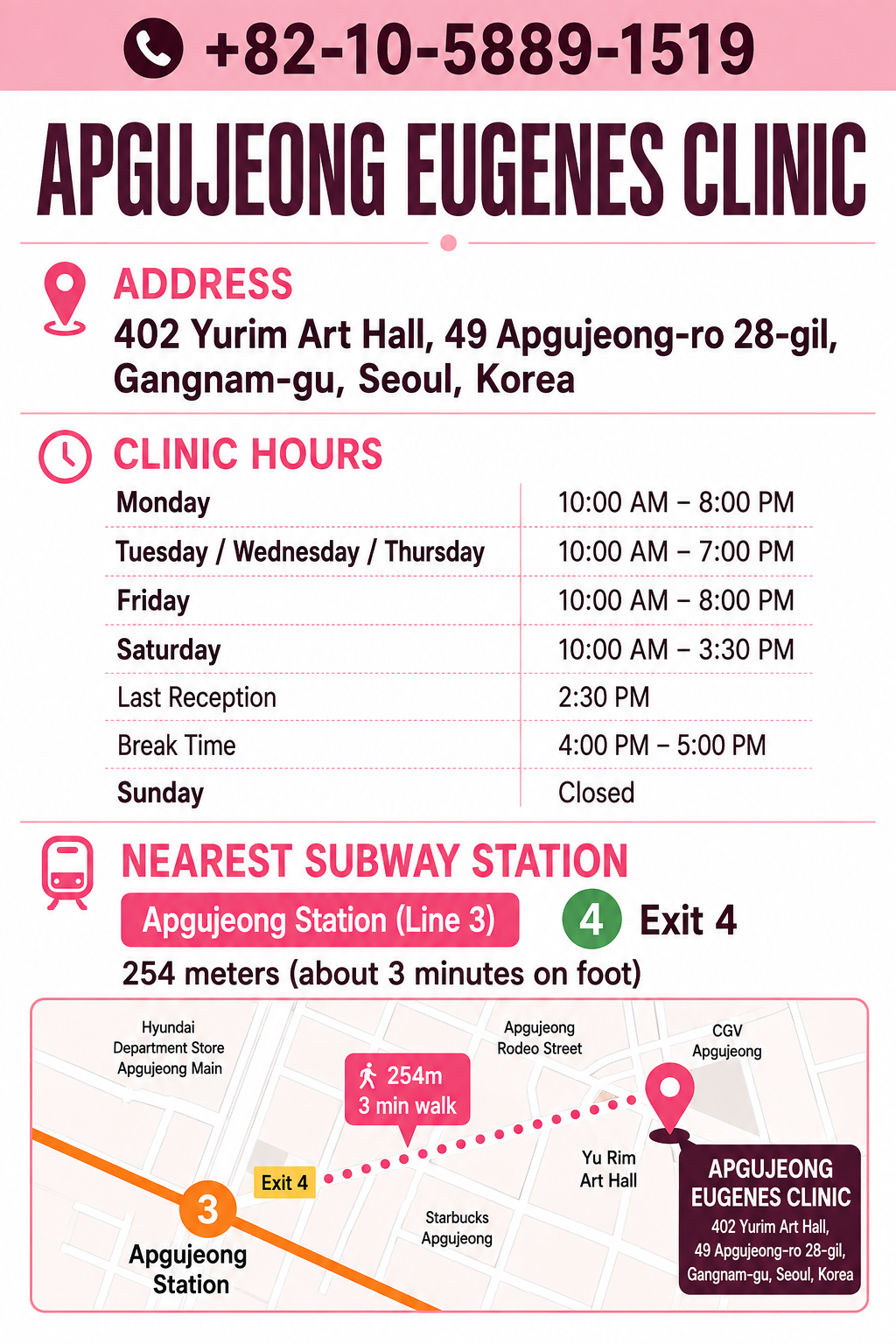
Chat on WhatsApp 402, Yurim Art Hall, 49 Apgujeong-ro 28-gil, Gangnam-gu, Seoul · Apgujeong Station (Line 3) Exit 4 · +82-10-5889-1519 (WhatsApp)