 Apgujeong Seoul
Anti-aging program
Anti-aging program · IV therapy
Stem Cell IV Therapy in Apgujeong, Seoul
Stem cell IV therapy at EU:GENES CLINIC in Apgujeong, Seoul costs ₩1,300,000 per IV session and ₩1,800,000 for IV + Face in one session (VAT excluded). The 6-session package is priced on inquiry. Every course starts with a doctor's consultation.
Stem cell IV therapy prices
All prices exclude VAT
| Option | Included | Price |
|---|---|---|
| IV | 1 intravenous session Doctor consultation included | ₩1,300,000 |
| IV + Face | 1 intravenous session + facial treatment Same visit | ₩1,800,000 |
| 6-session package | A planned course of 6 sessions Contact us for a quote | On inquiry |
All prices exclude VAT; your final amount including VAT is confirmed before treatment. Package pricing depends on the option and schedule you choose.
What stem cell IV therapy is
Stem cell IV therapy at our clinic is an intravenous infusion offered as part of the EU:GENES anti-aging program. The infusion is given through a drip in the arm while you rest, under medical supervision.
Patients usually choose it as a wellness and anti-aging treatment alongside skin procedures. Regenerative medicine is an evolving field. Responses differ between people, and the therapy does not replace treatment for any medical condition.
Ask what is in your infusion
Before treatment, the doctor explains the exact product, its source and how it is prepared. You can ask for this in writing.
Who it may suit
Adults in good general health who want to add an IV-based option to their anti-aging plan, including international visitors planning treatment during a stay in Seoul.
IV or IV + Face?
IV · ₩1,300,000
The intravenous session on its own. A good fit if your focus is overall wellness and you are already happy with your skin routine.
IV + Face · ₩1,800,000
The IV session plus a facial treatment in the same visit, for patients who also want to target skin quality on the face.
6-session package · on inquiry
For patients who want a planned course. The doctor proposes the interval between sessions. Message us for the package price and a schedule that fits your time in Korea.
What happens on the day
-
Consultation
The doctor reviews your health history, current medicines and goals, and explains the product and option recommended for you.
-
Preparation
The IV line is placed in a comfortable treatment room.
-
Infusion
You rest while the infusion runs. Staff monitor you during the session.
-
Face treatment (IV + Face only)
The facial part of the treatment is done in the same visit.
-
Aftercare
You can usually return to normal activities the same day. You leave with aftercare advice and a contact for questions.
Safety and who should wait
Possible short-term effects include bruising or tenderness at the IV site and occasional light-headedness. Tell staff straight away if you feel unwell during the infusion.
Speak to the doctor before booking if you are pregnant or breastfeeding, have an active infection, cancer or a history of cancer, an autoimmune or blood-clotting condition, or you take blood thinners or immune-suppressing medicine. The doctor may advise against treatment or ask you to wait.
Frequently asked questions
How much is stem cell IV therapy in Seoul?
At EU:GENES CLINIC in Apgujeong, one IV session is ₩1,300,000 and IV + Face is ₩1,800,000 per session, before VAT. The 6-session package is priced on inquiry.
How much is the 6-session package?
Package pricing depends on the option and schedule. Message us on WhatsApp for a quote.
How long does one session take?
Plan for about one to two hours including consultation and rest. IV + Face takes longer than IV alone.
Is there downtime?
Most patients return to normal activities the same day. You may have a small bruise where the IV was placed.
Can I have it during a short trip to Korea?
Yes. A single session fits into one visit. For a package, send your travel dates so the doctor can plan the session interval.
Can I combine it with other anti-aging treatments?
Often, yes. Many patients pair it with lifting or skin-booster treatments such as XERF with Rejuran aftercare. The doctor confirms timing at consultation.
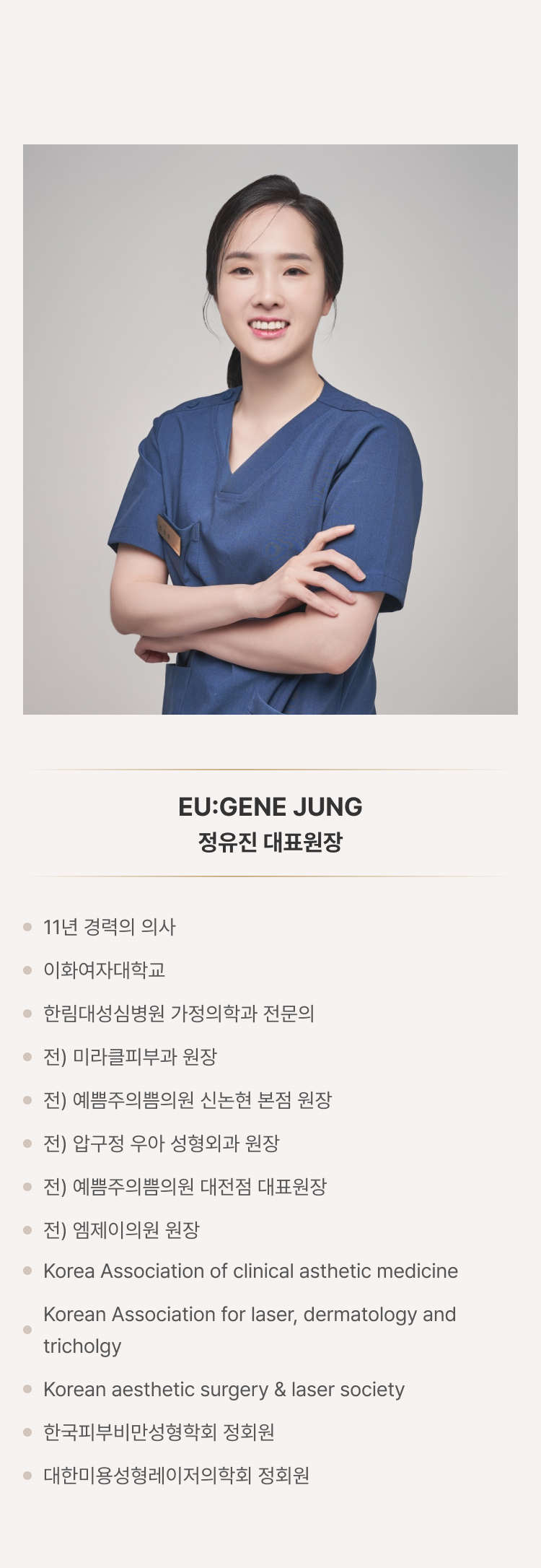
Medically reviewed by
Dr. Eugene Jung (정유진)
Medical director of EU:GENES CLINIC, Apgujeong. Physician with 11 years of clinical experience. Graduate of Ewha Womans University and board-certified in family medicine (Hallym University Sacred Heart Hospital). Former director at several aesthetic clinics in Seoul and Daejeon.
Member: Korean Association of Clinical Aesthetic Medicine · Korean Association for Laser, Dermatology and Trichology · Korean Aesthetic Surgery & Laser Society
The technology behind our stem cell IV therapy · ACTCELLBIO
Stronger. Longer-lasting. A more reliable start to regenerative therapy.
No chemical additives — only patented physical stimulation that fully awakens the innate regenerative power of your own cells.
Conventional PRP collects platelets. Activated PRP awakens them.
Why activation matters
From technology that separates platelets to technology that activates blood cells
The PRP market has competed on "how well it separates." It has missed the core value that determines treatment outcomes: activation.
Conventional PRP
Focused on separation and concentration
- Differentiates on centrifuge or plastic kit design
- Platelet concentration limited by centrifugation conditions
- Optimised for specific centrifuges only
- Activation not standardised — or done chemically
- Anticoagulant (ACD-A, pH 4.5–5.5) causes injection pain and dilutes PRP by 10–15%
- Growth-factor release stalls after 1–2 hours
ACTCELLBIO Activated PRP / PRF
Separation · concentration · activation
- Device-based physical activation using shear stress — no calcium or thrombin
- Consistent, standardised results that don't depend on the operator
- Captures the white, pink and red buffy-coat layers: 6cc from a 30cc draw (20%) vs. 3cc conventionally
- Activated PRF needs no anticoagulant — no acidic injection pain
- Activated cells form pseudopodia and adhere to tissue; release lasts 10–14 days
- One platform for PRP, PRF and bone-marrow concentrate (BMAC)
The platform
One core device, dedicated processing kits
Equipment, consumables and protocol work as one system — all registered with the Korean MFDS.
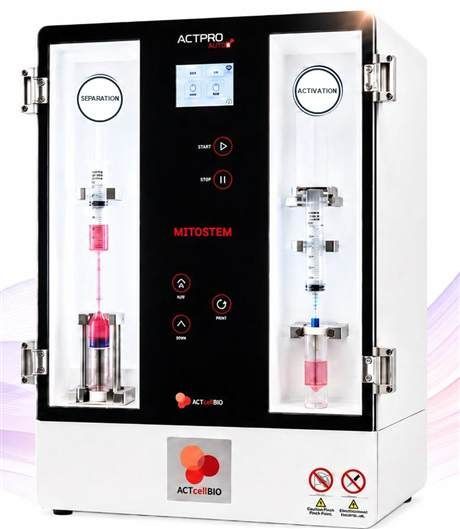
ACT PRO · MITOSTEM
Core device. Separates platelets, leukocytes and fibrin, and performs physical activation for PRP, PRF and BMAC.
Blood-cell activation device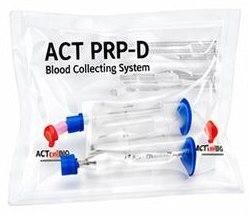
ACT PRP / ACT PRF
Blood-processing kits. Centrifuge autologous blood to extract platelets, leukocytes and fibrin. ACT PRP uses anticoagulant; ACT PRF uses none.
MFDS Permit No. 23-670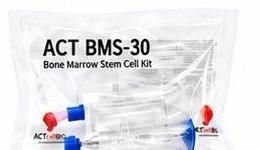
ACT BMS 30
Bone-marrow processing kit. Extracts blood cells, mesenchymal stem cells and hematopoietic stem cells from aspirated bone marrow.
MFDS Permit No. 24-404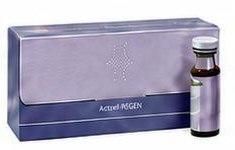
Actcell REGEN
Regenerative ampoule made from exosomes, PDRN and Cica. Mixed with activated PRF to create an autologous regenerative solution.
Notification No. 2956Treatment protocols
Three protocols from one platform
Activated PRP and activated PRF for local injection, plus activated PRP for intravenous infusion.
| Activated PRP — Local | Activated PRF — Local | Activated PRP — IV | |
|---|---|---|---|
| Anticoagulant | Pre-loaded syringe | None | Pre-loaded syringe |
| Blood draw | 30, 60 or 120cc | 30, 60 or 120cc | 60, 120 or 240cc |
| Final output | 6cc PRP per 30cc (automatic) | 15cc PRF per 30cc (automatic) | Activated after automatic separation |
| Application | Local injection | Local injection | IV infusion in normal saline |
Outpatient workflow
Injectable activated PRF in 14 minutes
A complete regenerative protocol in the outpatient clinic — no admission required.
Blood draw
30cc venous blood into a G-tube
Centrifuge
Transfer 15cc of supernatant
Pre-priming
Tube pre-priming
Activation
ACT PRO shear-stress activation
Injection
Precise injection into the lesion
No anticoagulant
Preserves the natural fibrin scaffold.
Shear-stress activation
Induces gradual growth-factor release.
6-hour window
Stays injectable with refrigerated storage.
In-situ scaffold
Liquid when injected, forms a scaffold at the lesion.
The science
Physical activation by shear stress
Shear stress is the frictional force created by velocity differences in a flowing fluid (Pa). Above a threshold, it triggers membrane deformation, receptor stimulation, signal transduction and growth-factor release.
Gauge-dependent activation
| Needle | Inner Ø | Shear stress | Activation rate |
|---|---|---|---|
| 12 G | 2.159 mm | 3 Pa | 8% |
| 14 G | 1.5 mm | 43 Pa | 12% |
| 18 G | 0.83 mm | 161 Pa | 48% |
| 23 G | 0.337 mm | 422 Pa | 94% |
Shear rate γ̇ = 4Q / πR³ · Shear stress τ = μ · γ̇
422 Pa exceeds the activation threshold of every blood cell
CD62P platelet-activation marker (gMFI) rose from 24.7 (control) to 83.0 in activated PRF.
Activation under the electron microscope
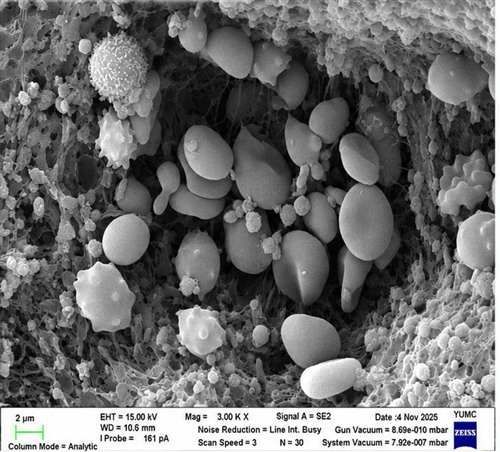
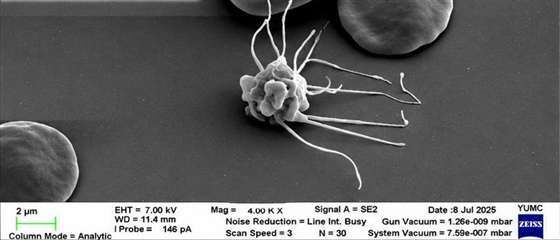
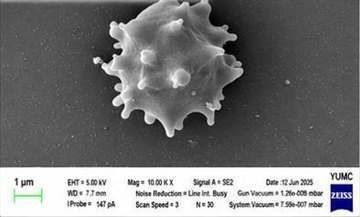
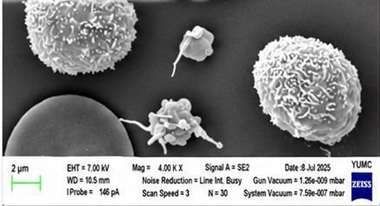
Imaged with a scanning electron microscope (MERLIN, ZEISS) at the Electron Microscopy Laboratory, Yonsei University.
Competitive comparison
Injectable activated PRF vs. other regenerative options
It combines the strengths of PRP and conventional PRF — a scaffold that can be injected — without the surgery, time or cost of cell-based alternatives.
| PRP | Conventional PRF | ADSC | SVF / BMSC | Injectable Activated PRF | |
|---|---|---|---|---|---|
| Source | Blood + anticoagulant | Blood | Liposuction | Fat harvest / bone-marrow aspiration | 30cc venous blood |
| Scaffold | No | Yes | — | — | Yes, forms in situ |
| Injectable | Yes | No (gel / membrane) | Yes | Yes | Yes |
| Preparation | Rapid GF burst | Mainly dental / bone graft | ~120 min+ | Enzymatic processing / culture | 14 minutes |
| Burden | Low | Low | High cost, surgery | Regulatory burden, surgery | Low cost, non-surgical, repeatable |
PRF G-CAP cold protection
From 3 minutes to 6 hours: a 120× longer injection window
Without anticoagulant, PRF clots in about 3 minutes at room temperature. The G-Cap sleeve wraps the syringe barrel and keeps it at 4–8°C, preserving the pre-fibrin stage and reducing coagulation-enzyme activity by over 90%.
All times based on refrigerated storage at 4–8°C (ice water) with the G-Cap barrel sleeve fitted.
Clinical applications
A multidisciplinary regenerative platform
Injectable activated PRF isn't limited to one specialty — it connects many clinical departments.
Orthopedics & Sports
Rotator cuff, tennis elbow, knee osteoarthritis, tendinopathy, plantar fasciitis.
Pain & Rehabilitation
Spine and joint pain, facet and SI joints, muscle, tendon and ligament recovery.
Dermatology & Aesthetics
Full-face rejuvenation, acne and depressed scars, keloids, chronic wounds.
Scalp & Hair Loss
Androgenetic alopecia and alopecia areata; follicle regeneration.
Dentistry & Oral Surgery
Extraction sockets, periodontal tissue, bone grafting, TMJ disorders.
Ophthalmology
Dry eye, corneal epithelial disorders, ocular-surface regeneration.
ENT
Post-viral loss of smell (olfactory cleft injection), chronic rhinitis, vocal-fold atrophy.
OB/GYN & Urology
Thin endometrium, genitourinary syndrome of menopause, stress urinary incontinence.
Knee · Shoulder · Plantar fascia
Lesion site:
6cc concentrated activated PRF — direct, high-concentration growth factors for focused regeneration.
Surrounding tissue:
9cc activated PRF — regulates inflammation and creates a broad regenerative environment.
Total:
15cc from one 30cc draw.
Healing course: inflammation and pain begin to ease in days 1–3 · neovascularisation and fibroblast activation in weeks 1–2 · collagen synthesis in weeks 2–6 · remodelling from week 6.
Hematopoietic Mitocell IV (αABC IV Therapy)
Autologous activated blood-cell IV therapy. Indications include liver function, hyperlipidemia, blood flow, cardiovascular and cerebrovascular disease, hypertension, diabetes, chronic fatigue, atopic dermatitis, psoriasis, menopausal disorders, sexual function, dementia, Parkinson's disease and varicose veins.
Recommended protocol: 60cc weekly × 12 → 120cc every 2 weeks × 6 → 240cc monthly × 3. Can be combined with IVNT, placenta injections and Thymosin Alpha 1. Blood tests before and after are required to compare results.
For patients with myocardial infarction or coronary stents, direct IV delivery requires caution; local subcutaneous activated PRF is the preferred route.
Clinical cases
Clinical case reports
Cases from partner clinics using ACTCELLBIO activated PRF.
9-year intractable pain and soft-tissue fibrosis
After failed treatment elsewhere for 9 years, injection into 2cm-thick fibrotic tissue converted the chronic inflammatory environment into a regenerative state — not just short-term pain relief.
Restoring whole-body balance and range of motion
Growth factors injected around contracted muscles and joints induced immediate relaxation, restoring a full squat that stiff ankles had made impossible.
Psoriasis, atopic dermatitis and pruritus
Subcutaneous activated fibrin injection 2–3 times at 2-week intervals produced rapid improvement.
Palmoplantar pustulosis and severe psoriasis
Combined IV and intralesional injection eliminated discharge and cracking and rebuilt the skin barrier.
Diabetic foot ulcer reconstruction
Activated PRF combined with full debridement and local dressing regenerated new tissue in a severe necrotic ulcer.
Hair-follicle regeneration
About 5cc of activated fibrin from a 30cc draw, injected 0.5–1cc per site near the deep dermis every 3 weeks (PRF microneedling + Actcell REGEN).
Individual results vary. Case summaries are shared with identifying details removed. This information is intended for medical professionals; consult a specialist for diagnosis and treatment.
An upgrade for PRP users. The best start for everyone else.
Detailed mechanism papers — skin aesthetics, hair loss, keloids, atopic dermatitis and psoriasis — and full clinical data are available on request.
Ask on WhatsApp