Laser Guide · Apgujeong, Gangnam Seoul
Pico Laser for Sunspots: How Pigmentation Type Affects Treatment Choice

Quick answer
Picosecond (pico) lasers deliver ultra-short pulses that break pigment into tiny particles the body clears over weeks. Well-defined sunspots (solar lentigines) and freckles often respond in 1–3 sessions. Melasma, post-inflammatory hyperpigmentation and deeper pigment behave differently and need gentler, longer plans because aggressive treatment can cause rebound darkening. Correctly identifying the pigment type is therefore the most important step before choosing any laser.
Results and recovery vary between individuals.
What is a pico laser and how does it treat pigment?
Pigment lasers work by selectively heating melanin. Older Q-switched lasers use nanosecond pulses; picosecond lasers use pulses roughly a thousand times shorter. The idea is that very short pulses create a stronger mechanical (photoacoustic) effect with less heat spreading into surrounding skin, breaking pigment into finer fragments.
Studies suggest picosecond and Q-switched lasers can both clear sunspots well; picosecond devices may cause less post-inflammatory darkening in some patients, but head-to-head evidence is mixed, and results depend heavily on settings and skin type.
Why does pigmentation type change the treatment?
| Pigment type | What it looks like | General approach |
|---|---|---|
| Solar lentigo (sunspot) | Flat, sharply defined brown spot on sun-exposed skin | Spot-targeted laser; often few sessions |
| Freckles (ephelides) | Small, light-brown spots that darken in summer | Responds well but tends to return with sun |
| Melasma | Blurry, symmetrical patches on cheeks, forehead, upper lip | Low-energy, gradual plans plus skincare; high relapse risk |
| Post-inflammatory hyperpigmentation (PIH) | Brown marks after acne, burns or irritation | Gentle approach; time, sun protection, topicals |
| Hori's nevus / ABNOM | Grey-brown speckles on cheeks, deeper in skin | Multiple sessions; deeper wavelengths |
| Seborrheic keratosis | Raised, rough, "stuck-on" brown lesion | Often better with other methods than toning lasers |
Many people have more than one type at the same time – for example sunspots on top of melasma – which is why a careful skin examination comes before any laser plan.
What does treatment and recovery look like?
- Diagnosis. The doctor examines spots, sometimes with magnification, to rule out lesions that need medical evaluation.
- Treatment. Each spot is targeted with short pulses; it feels like quick snaps. Numbing cream may be used.
- Darkening and flaking. Treated spots often turn darker and form fine crusts that shed over about 5–10 days.
- Review. Remaining pigment is reassessed after 4–6 weeks.
What are the risks, and who should be careful?
Common, temporary
- Redness and mild swelling for a few hours to days
- Darkened spots and fine crusts
Risks to discuss
- Post-inflammatory hyperpigmentation, more common in darker skin tones
- Hypopigmentation (lighter spots), especially with repeated high-energy treatment
- Melasma worsening with aggressive settings
- Recurrence without daily sun protection
People who are pregnant, recently tanned, taking photosensitising medication or with a history of keloids should discuss this first. Any spot that is changing, bleeding or irregular should be checked medically before cosmetic treatment.
Is pico laser right for me, and what are the alternatives?
Pico lasers are one option among several. Depending on your pigment type, doctors may consider other laser or light-based devices, topical treatments such as tranexamic acid or retinoids, or simply strict sun protection. Pico lasers are not offered at every clinic, so it is worth asking which pigment options are available and discussing them at your consultation.
If your main concern is overall skin quality alongside spots, boosters such as Rejuran may be part of a wider plan, though they do not remove pigment directly.
How should I prepare for pigment laser treatment?
- Avoid tanning for at least 2–4 weeks before treatment; tanned skin absorbs more energy and reacts more strongly.
- Pause irritating products such as strong retinoids or acids for a few days, unless your doctor advises otherwise.
- Mention cold sores if you get them around the mouth, as heat can trigger them.
- Plan around your trip. Treated spots may look darker for about a week, which matters for photos or events.
- Keep realistic timelines. Final results are best judged 4–6 weeks after each session.
Visitors to Seoul often prefer treating spots early in their stay so any crusting has shed before they fly home.
How much does pigment laser treatment cost?
In Seoul, a pico laser pigment session typically costs about ₩50,000–₩400,000, a wide range because sources disagree and promotions vary; pico toning typically costs about ₩50,000–₩200,000 per session, and small spot removal with CO2 or Nd:YAG lasers about ₩1,000–₩20,000 per spot (indicative 2026 ranges). Cost is usually driven by the number and size of spots, whether you need spot treatment or full-face toning, the number of sessions and the device used. A personalised plan and quote are confirmed at consultation.
Ranges are indicative market figures from public price-comparison sources as of October 2026. The final quote depends on the clinic, the product or device, the quantity and VAT.
Frequently asked questions
Can pico laser remove sunspots completely?
Many well-defined sunspots fade significantly in 1–3 sessions, but complete removal cannot be guaranteed and new spots can form with sun exposure.
Is pico laser good for melasma?
It may help some patients when used gently over many sessions, but melasma often relapses and aggressive laser can worsen it.
Is pico laser better than Q-switched laser?
Both can treat sunspots. Pico lasers may cause less heat damage, but studies comparing them show mixed results.
What is the downtime?
Treated spots usually darken and flake over about 5–10 days. Full-face low-energy sessions have less visible downtime.
Do I need sunscreen afterwards?
Yes. Daily broad-spectrum sunscreen is essential to reduce darkening and recurrence.
Discuss pigmentation options in Apgujeong, Gangnam Seoul
Send a clear, makeup-free photo of your spots on WhatsApp. An English-speaking consultation can help identify your pigment type and suitable options.
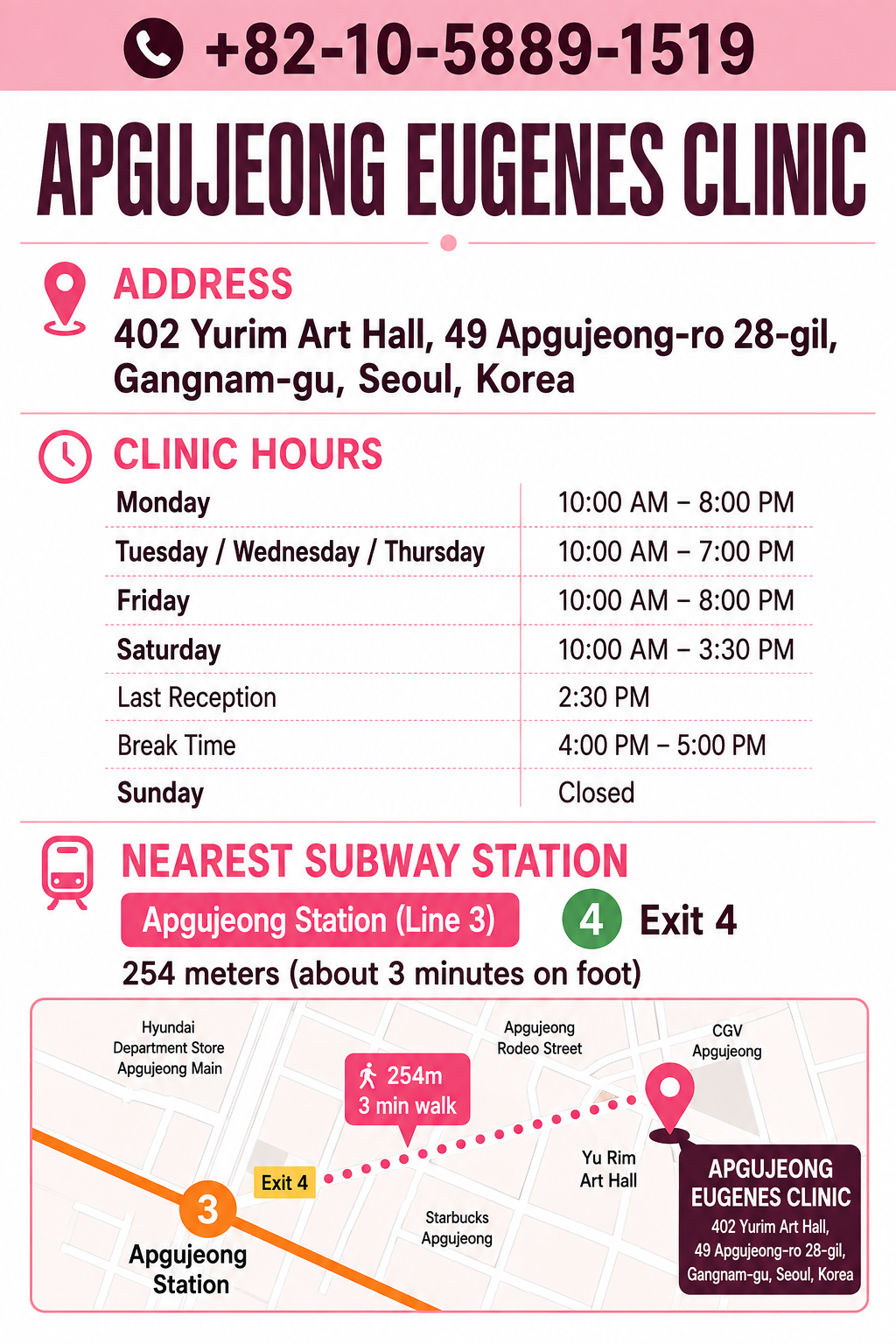
Chat on WhatsApp 402, Yurim Art Hall, 49 Apgujeong-ro 28-gil, Gangnam-gu, Seoul · Apgujeong Station (Line 3) Exit 4 · +82-10-5889-1519 (WhatsApp)