Evidence Guide · Apgujeong, Gangnam Seoul
PRP Facial Rejuvenation: What Do Clinical Studies Actually Support?

Quick answer
Platelet-rich plasma (PRP) uses a concentrate of your own platelets, rich in growth factors, injected or applied to the skin. Clinical studies, mostly small and varied in method, suggest PRP may modestly improve skin texture and acne scars, especially when combined with microneedling or lasers. Evidence for PRP alone as an anti-aging treatment is weaker and inconsistent, largely because preparation methods are not standardised. Results are subtle and usually need several sessions.
Results and recovery vary between individuals.
What is PRP and how is it made?
A small amount of blood is drawn from your arm and spun in a centrifuge to separate a plasma layer rich in platelets. Platelets release growth factors involved in tissue repair, and the theory is that concentrating them in the skin encourages collagen production and healing. PRP is injected with fine needles or applied during microneedling.
Because it comes from your own blood, allergic reactions are very unlikely – but that does not automatically mean it is highly effective.
What do clinical studies actually support?
| Use | What studies suggest | Strength of evidence |
|---|---|---|
| Atrophic acne scars (with microneedling or fractional laser) | Several trials and reviews suggest better results or faster recovery than the device alone | Moderate, but small studies |
| General skin rejuvenation (texture, fine lines) | Some improvement in small trials; results vary | Low to moderate |
| Under-eye dark circles and crepiness | Small studies show modest improvement | Low |
| Volume replacement or lifting | Not supported; PRP is not a filler | Very low |
A key problem is variability: studies use different spin methods, platelet concentrations, activation and session numbers, so results are hard to compare or predict for an individual.
Why are PRP results so variable?
- Preparation. Platelet concentration can differ several-fold between kits and protocols.
- Your own blood. Age, health, medications and even hydration influence platelet quality.
- Technique and depth. Injection versus topical application with microneedling gives different exposure.
- Outcome measures. Many studies rely on subjective ratings rather than objective skin measurements.
What are the risks and who should avoid PRP?
Common effects
- Redness, swelling and pinpoint bleeding for 1–3 days
- Bruising at injection sites or the blood draw
- Temporary tenderness
Who should avoid or postpone
- Blood or platelet disorders, low platelet count
- Active infection, skin cancer in the area or ongoing chemotherapy
- Anticoagulant or strong antiplatelet use
- Pregnancy or breastfeeding
Rare risks include infection and, if injected deeply, vascular complications. Hygiene and proper technique are essential.
What are evidence-based alternatives?
If your goal is better skin quality, treatments with clearer product standardisation may be worth comparing. Polynucleotide boosters such as Rejuran and PDRN injections have a growing (though still limited) body of clinical studies. For acne scars, RF microneedling such as Potenza is often used, sometimes combined with boosters.
PRP is not offered at every clinic, so ask which regenerative options are available and how their evidence compares at your consultation.
Is PRP worth trying, and how do I set expectations?
PRP may be reasonable for people who prefer an autologous (own-blood) treatment and accept that results are uncertain and usually subtle. It tends to make most sense as an add-on – for example with microneedling for acne scars – rather than as a stand-alone anti-aging treatment.
- Ask how the PRP is prepared and what platelet concentration the kit is designed to achieve.
- Agree on how results will be judged, such as standardised photos before and after.
- Compare it with treatments whose products are standardised and whose evidence base is clearer.
If you are visiting Seoul for a short time, remember that most PRP protocols involve several sessions spaced a month apart.
How many sessions are needed and what does it cost?
Studies commonly use about 3 sessions spaced 4 weeks apart, with maintenance once or twice a year if helpful. Visible change, when it occurs, is gradual over weeks. In Seoul, a facial PRP session typically costs about ₩100,000–₩300,000 (indicative 2026 range). Cost depends on the kit, whether it is combined with microneedling or lasers, and the number of sessions. A quote is confirmed at consultation.
Ranges are indicative market figures from public price-comparison sources as of October 2026. The final quote depends on the clinic, the product or device, the quantity and VAT.
Frequently asked questions
Does PRP really work for the face?
Studies suggest modest benefits, mainly for acne scars when combined with microneedling or lasers. Evidence for PRP alone is weaker and inconsistent.
Is PRP a vampire facial?
The term usually refers to PRP applied during microneedling. It is the same basic idea.
How long until I see PRP results?
If improvement occurs, it develops gradually over several weeks and usually after more than one session.
Is PRP safe?
It is generally well tolerated because it uses your own blood, but bruising, swelling and rare infection can occur.
Can PRP replace filler?
No. PRP does not add meaningful volume or lift.
Compare regenerative options in Apgujeong, Gangnam Seoul
Tell us your skin goals on WhatsApp. An English-speaking consultation will explain which regenerative treatments have the strongest evidence for you.
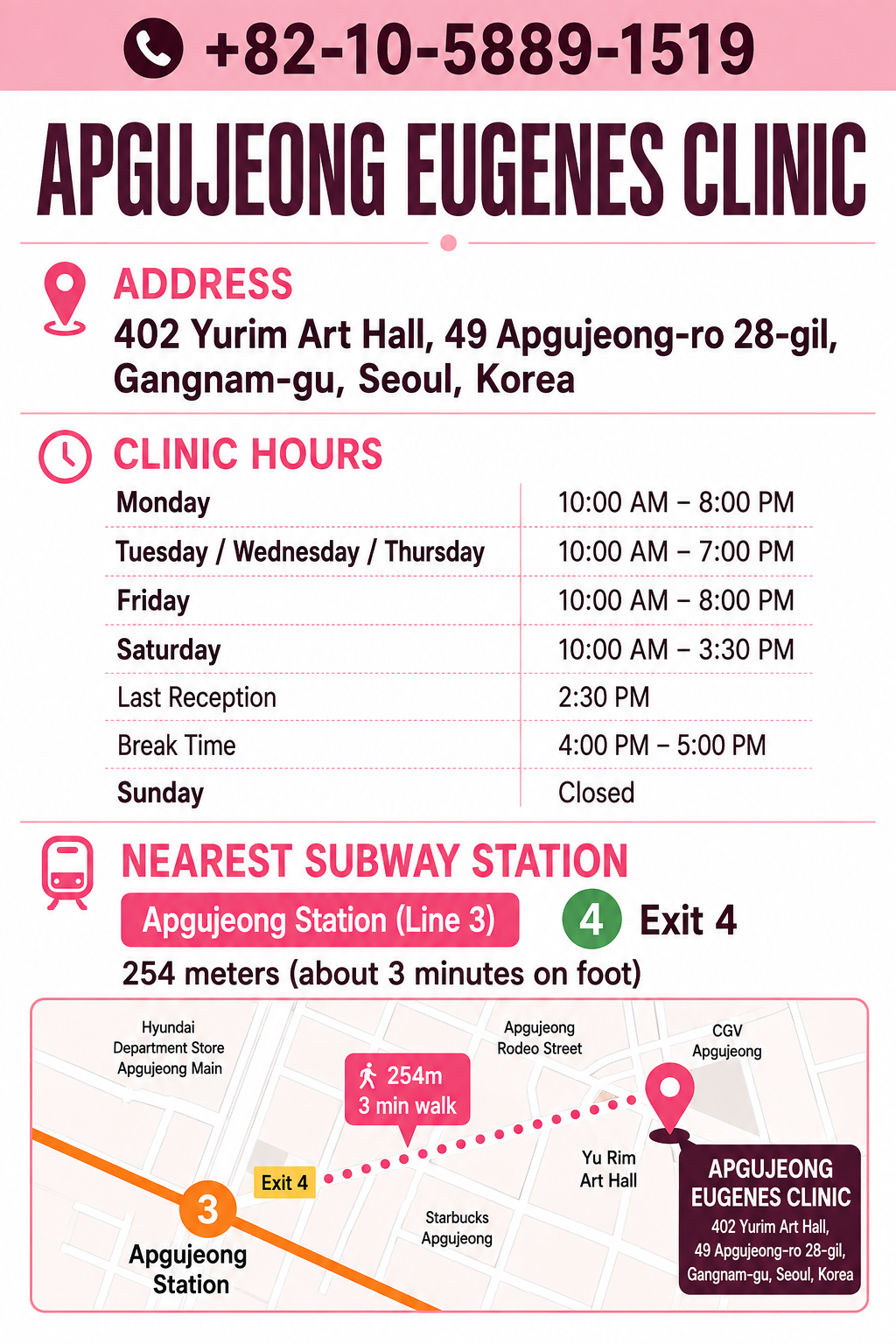
Chat on WhatsApp 402, Yurim Art Hall, 49 Apgujeong-ro 28-gil, Gangnam-gu, Seoul · Apgujeong Station (Line 3) Exit 4 · +82-10-5889-1519 (WhatsApp)