Injectables Guide · Apgujeong, Gangnam Seoul
Chin Filler for Facial Balance: How Much Volume Is Typically Considered?

Quick answer
For chin filler, many doctors start with roughly 1–2 cc of a firm hyaluronic acid (HA) filler, while a weak or very short chin may need more, often staged over two visits. The right amount depends on your profile, chin projection, lip position and the look you want. A subtle, balanced result is generally safer and more natural than placing a large volume at once. Effects are immediate and often last around 9–18 months.
Results and recovery vary between individuals.
Why does the chin matter for facial balance?
The chin anchors the lower third of the face. A short or receding chin can make the nose look larger, the lips look more protruding and the jawline less defined. Adding a small amount of projection or length can improve side-profile harmony without changing your features dramatically.
Doctors often look at the side profile (for example, the relationship between the nose tip, lips and chin) and front proportions (the height of the lower face relative to the mid-face). These guides are not rigid rules – facial ideals vary by ethnicity and personal preference.
How much chin filler is typically used?
| Goal | Volume often considered* | Notes |
|---|---|---|
| Subtle refinement or smoothing | About 0.5–1 cc | Softens a mild dimple or adds a small point |
| Moderate projection | About 1–2 cc | Most common for profile balancing |
| Short or receding chin | 2 cc or more, often staged | Built up over 2 visits to judge tissue response |
*Approximate ranges used in clinical practice; your doctor decides based on examination. Large volumes in one session can increase swelling and risk.
Which filler is used for the chin?
The chin needs a filler that holds shape under muscle movement. Firmer, more cohesive HA fillers are commonly chosen because they can be dissolved with hyaluronidase if needed. Calcium hydroxylapatite such as Radiesse is another option that adds structure and stimulates collagen, but it cannot be dissolved the same way, so it suits patients who are sure about their goal.
Filler can add projection and length, but it cannot fully replace a chin implant or jaw surgery in severe retrusion or bite problems.
What happens during treatment?
- Assessment and photos. Front and side views are checked and the target shape is discussed.
- Numbing. Topical cream and lidocaine-containing filler reduce discomfort.
- Injection. Filler is placed deep near the bone, by needle or blunt cannula, in small amounts.
- Moulding and review. Shape is checked from all angles before finishing.
What are the risks and who should avoid chin filler?
Common and temporary
- Swelling, tenderness and bruising for a few days
- Firmness or mild unevenness while settling
Uncommon but important
- Vascular occlusion (filler blocking a blood vessel) – rare, needs urgent treatment
- Infection or delayed nodules
- Overcorrection, a "witch's chin" look or migration
Avoid or delay treatment during pregnancy or breastfeeding, with active skin infection or cold sores, or after recent dental work in the area. Tell your doctor about autoimmune disease and blood thinners.
How long does chin filler last?
Because the chin is a relatively low-movement, deep area, HA filler often lasts around 9–18 months, depending on the product, volume and your metabolism. Many patients top up with a smaller amount once the first result softens.
A common mistake is chasing a dramatic change with each top-up. Filler that has not fully dissolved, plus new product, can gradually make the chin heavy or overly long. A good practice is to compare current photos with your pre-treatment photos before adding more, and to accept that a small amount may be all you need.
Chin filler and the jawline
Chin projection and jawline definition are linked. For some faces, a small amount of filler along the jaw angle or a muscle-relaxing treatment for a bulky masseter gives better balance than adding more volume to the chin alone. Your doctor will look at the whole lower face before suggesting a total volume.
How much does chin filler cost in Seoul?
There is no single fixed price for chin filler. In Seoul, chin filler using about 1–2 cc of HA typically costs about ₩150,000–₩500,000 (indicative 2026 range). Korean HA brands typically run about ₩100,000–₩250,000 per cc and imported brands about ₩250,000–₩500,000 per cc. Radiesse, sometimes used for chin projection, typically costs about ₩250,000–₩600,000 per 1.5 cc syringe. Cost depends on the filler brand, the number of syringes, and whether other areas such as the jawline are treated. Your plan and quote are confirmed at consultation. See more on filler treatments.
Ranges are indicative market figures from public price-comparison sources as of October 2026. The final quote depends on the clinic, the product or device, the quantity and VAT.
Frequently asked questions
How many cc of filler do I need for my chin?
Many people need about 1–2 cc; a very short chin may need more, often staged. The exact amount is decided after examination.
Can chin filler make my nose look smaller?
Better chin projection can make the nose look more balanced in profile, although the nose itself does not change.
Is chin filler reversible?
HA filler can usually be dissolved with hyaluronidase. Radiesse cannot be dissolved in the same way.
How long is the swelling?
Usually a few days, with most bruising fading within a week.
Is chin filler better than an implant?
Filler is non-surgical and adjustable but temporary. An implant is permanent and may suit more severe cases; a surgeon can advise.
Plan a balanced chin in Apgujeong, Gangnam Seoul
Send front and side profile photos on WhatsApp. An English-speaking consultation will suggest a realistic volume for your proportions.
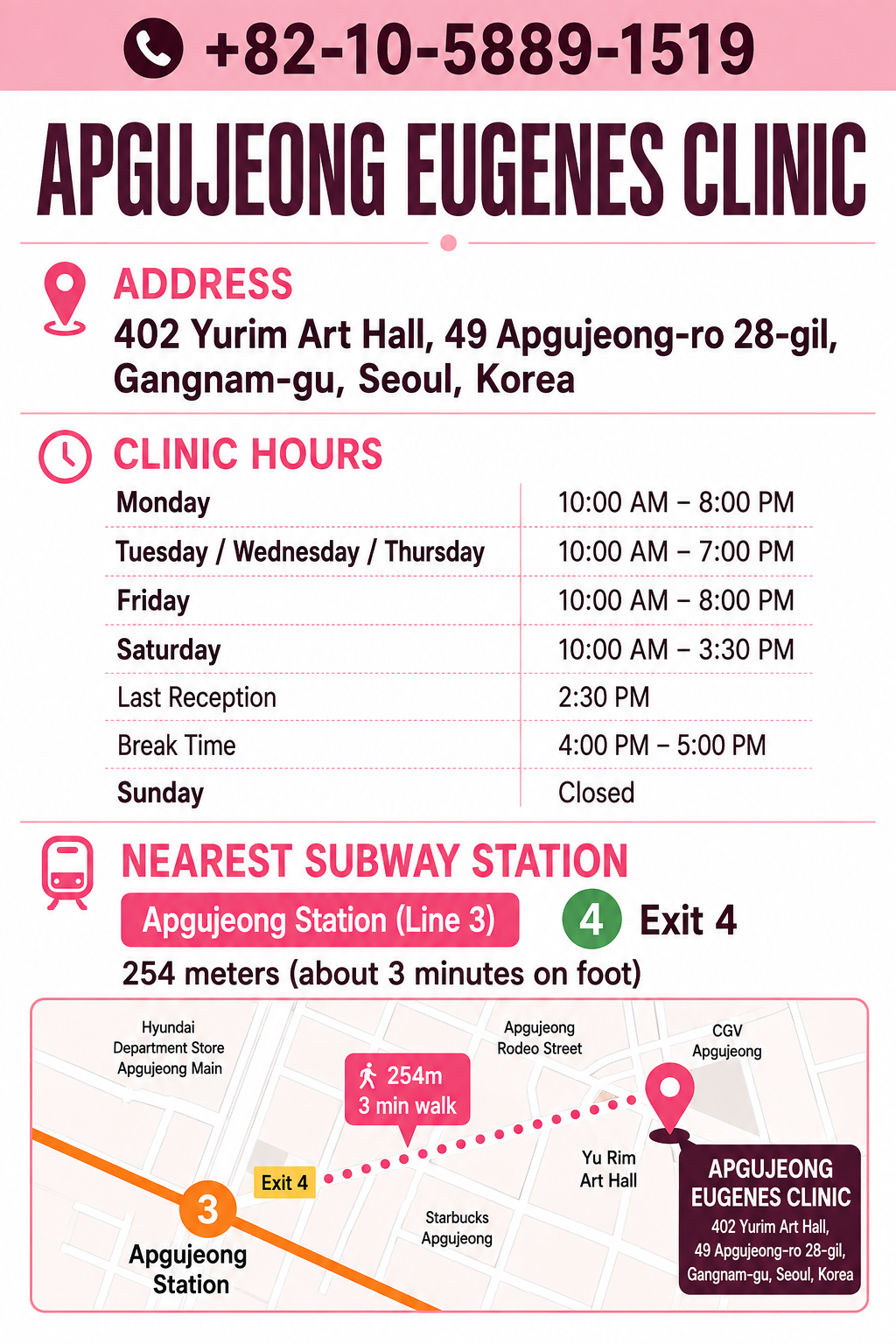
Chat on WhatsApp 402, Yurim Art Hall, 49 Apgujeong-ro 28-gil, Gangnam-gu, Seoul · Apgujeong Station (Line 3) Exit 4 · +82-10-5889-1519 (WhatsApp)