Skin Care Guide · Apgujeong, Gangnam Seoul
Aqua Peel for Oily and Congested Skin: Benefits and Treatment Frequency

Quick answer
An aqua peel (hydradermabrasion) combines gentle exfoliation, water- or serum-based cleansing and suction to loosen dead skin, excess oil and surface debris from pores. For oily and congested skin it can make the skin feel cleaner and look smoother for days to a few weeks. It does not shrink pores permanently, control oil long-term or treat inflammatory acne on its own. Many people repeat it about every 2–4 weeks as maintenance.
Results and recovery vary between individuals.
What is an aqua peel?
An aqua peel is a non-invasive facial treatment that uses a handpiece with a textured or spiral tip. As it moves over the skin, it delivers liquid (often containing mild acids such as salicylic or glycolic acid, or hydrating solutions) while vacuum suction lifts away loosened dead cells, oil and debris. Branded versions such as Hydrafacial are based on a similar idea.
Compared with traditional extraction facials, it is usually gentler and more consistent, and compared with chemical peels, there is generally no peeling afterwards.
What are the benefits for oily and congested skin?
What it can do
- Remove surface oil, dead skin and some blackhead debris
- Make skin feel smoother and look brighter
- Help skincare absorb more evenly afterwards
- Fit easily into a short visit with no downtime
What it cannot do
- Permanently shrink pores
- Reduce oil production for months
- Treat inflamed, cystic acne by itself
- Improve acne scars or deep texture
Evidence for hydradermabrasion is limited to small studies, which mostly report short-term improvements in hydration, smoothness and appearance. It is best viewed as a maintenance and skin-hygiene treatment rather than a medical acne therapy.
How often should you get an aqua peel?
| Skin situation | Frequency often suggested |
|---|---|
| Very oily, congested skin | About every 2–3 weeks at first, then monthly |
| Combination skin with occasional congestion | About every 4 weeks |
| Sensitive or easily irritated skin | Every 4–6 weeks, with gentle solutions |
| Before an event | 2–5 days beforehand |
Frequency is a general guide. Over-exfoliating can damage the barrier and, paradoxically, make oily skin feel more irritated.
Who should avoid an aqua peel?
- Active inflamed acne, cysts or pustules over a large area
- Active rosacea flare, eczema, sunburn or open wounds
- Recent isotretinoin use or strong retinoid irritation
- Allergy to salicylic acid or other solution ingredients
- Cold sores or other skin infection in the area
Mild redness for an hour or two is normal. Stinging, persistent redness or breakouts after treatment should be reported so the solution or frequency can be adjusted.
What are the alternatives for oily skin and enlarged pores?
If congestion keeps returning, the underlying oil production or pore structure may need a different approach:
- Skin Botox(very diluted superficial toxin) may reduce oiliness for a few months – see skin Botox.
- RF microneedling such as Potenza targets pore appearance and texture through collagen remodelling.
- Chemical peels or medical skincare (retinoids, salicylic acid) for ongoing congestion.
- Acne treatment with a doctor if breakouts are inflammatory.
More options are covered in the pore tightening guide. Aqua peel is not offered at every clinic, so ask about current options at your consultation.
Can an aqua peel be combined with other treatments?
Yes – an aqua peel is often used as a preparation or finishing step. Cleansing the skin first can help a following treatment, such as a skin booster or LED light, start on a clean surface. However, combining it with strong treatments on the same day needs care:
- Avoid aqua peel with acid solutions right before or after a chemical peel or ablative laser.
- After RF microneedling or injections, wait until the skin has fully closed and settled, usually several days.
- For very oily skin, it may complement skin Botox or medical skincare, rather than replace them.
Your doctor can suggest a sequence that fits your skin and time in Seoul.
Aftercare and cost
After an aqua peel, cleanse gently, use a light non-comedogenic moisturiser and sunscreen, and avoid scrubs, acids and retinoids for a day or two. In Seoul, an aqua peel session typically costs about ₩30,000–₩100,000 (indicative 2026 range). Cost depends on the device, the solutions used and add-ons. A plan and quote are confirmed at consultation.
Ranges are indicative market figures from public price-comparison sources as of October 2026. The final quote depends on the clinic, the product or device, the quantity and VAT.
Frequently asked questions
Does an aqua peel help blackheads?
It can loosen and remove some surface blackhead debris, but blackheads usually return without ongoing care.
How long do aqua peel results last?
Usually days to a few weeks, which is why it is often repeated every 2–4 weeks.
Is aqua peel good for acne?
It may help mild congestion, but it is not a treatment for inflamed or cystic acne, which needs medical care.
Is there downtime?
Generally none. Mild redness may last an hour or two.
Is aqua peel the same as Hydrafacial?
They are based on a similar hydradermabrasion idea; devices and solutions differ by brand.
Ask about oily skin solutions in Apgujeong, Gangnam Seoul
Send a close-up photo of your pores and breakouts on WhatsApp. An English-speaking consultation will suggest a realistic plan for oil and congestion.
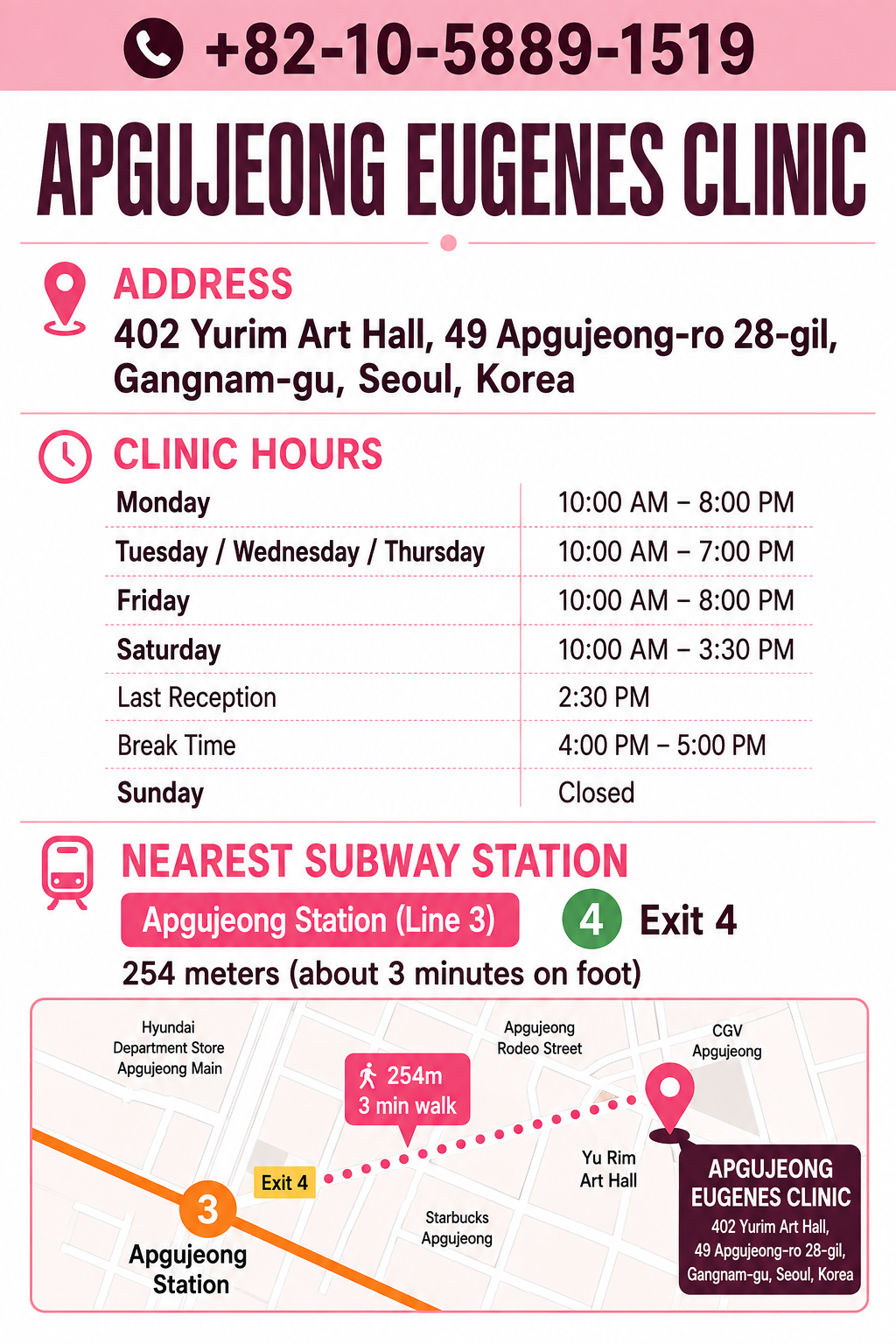
Chat on WhatsApp 402, Yurim Art Hall, 49 Apgujeong-ro 28-gil, Gangnam-gu, Seoul · Apgujeong Station (Line 3) Exit 4 · +82-10-5889-1519 (WhatsApp)